How to Roll Out AI Across a Sri Lankan Company in 90 Days
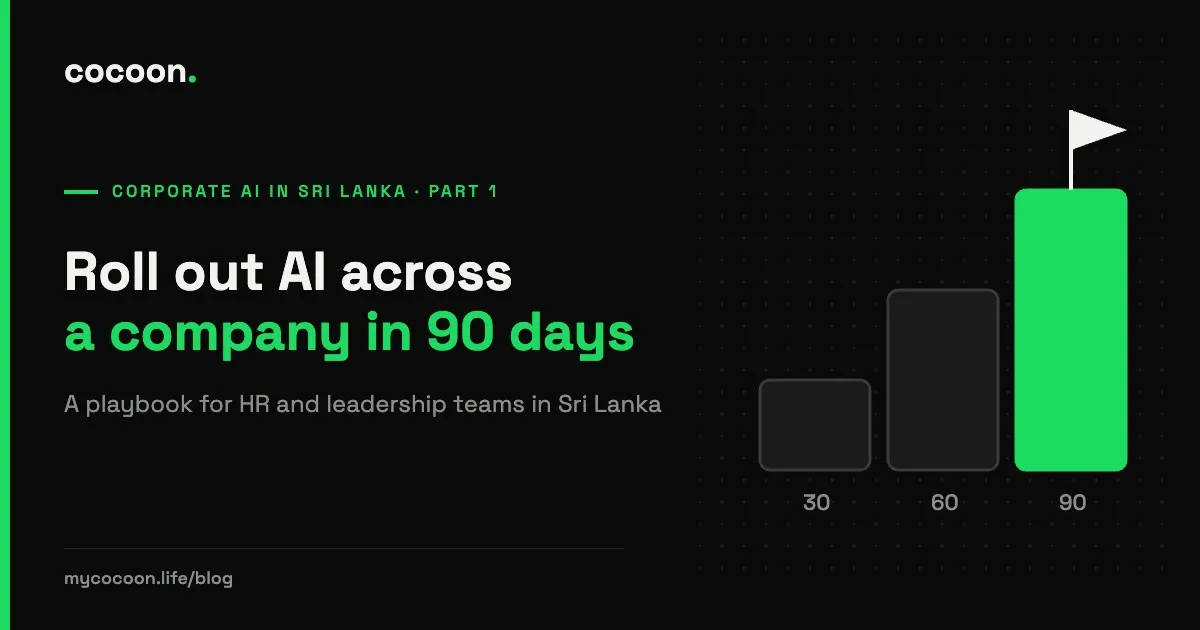
A 90-day AI rollout works in three phases: in days 1 to 30, measure where people are and set the rules; in days 31 to 60, train people hands-on using their own work; in days 61 to 90, measure again, automate one or two workflows and decide what to scale. In Sri Lanka, build three local realities in from the start: the data protection duties due on 1 January 2027, teams who think in Sinhala and Tamil as well as English, and a workplace culture where seniority and saving face shape who will try something new in public.
AI is already in your company
Whether or not your company has an AI strategy, your people already have one. It lives on their phones.
The World Bank's South Asia Development Update in October 2025 found that 7.3% of white-collar job postings in Sri Lanka asked for AI skills in 2025, the highest share in the region, and ranked Sri Lanka second in South Asia for ChatGPT users per head. The Institute of Policy Studies estimates that 22.8% of employed Sri Lankans, around 1.83 million people, work in jobs exposed to generative AI.
So the real question for a Sri Lankan leadership team is not whether to bring AI in. It is whether to shape how it is already being used, or to find out later what happened while nobody was looking.
This is the playbook we would follow to shape it. It is written for HR and L&D heads, CEOs and department heads, and it fits in one quarter.
Why 90 days?
Ninety days is long enough to change habits and short enough to hold a leadership team's attention. It lines up with a quarterly board cycle, so the day-90 report lands where decisions get made. And it forces a useful discipline: every phase has to end with something you can show, not just something you attended.
Baseline every team. Issue a staff AI guideline. Name champions. Shortlist real use cases.
Hands-on, role-based sessions. Every team leaves with one thing that runs. Start a shared library.
Measure again. Automate one or two workflows. Decide what to scale, from evidence.
Before day one: four decisions
Four decisions need to be made by leadership before anyone books a trainer. Skip them and the programme drifts.
Three outcomes, with numbers. Not "become AI-ready". Something like: cut the time to close the month by two days, answer guest messages within an hour, or halve the time to produce a tender. Outcomes decide which teams go first.
One owner. A named person with AI adoption in their objectives. Usually the HR or L&D head, with the CEO as visible sponsor.
A tools budget, not just a training budget. People forget what they cannot practise. If the training uses tools nobody has access to afterwards, the skill fades within weeks.
Time. Department heads have to agree that learning happens during working hours. In a lean Sri Lankan team that is a real cost, and it is the one most likely to be quietly withdrawn in week three.
Days 1 to 30: see it and set the rules
Measure first. You cannot train what you cannot see. A short readiness score for every person gives you a baseline, shows which teams are ahead and which are stuck, and gives you something to compare at day 90. Our free AI Readiness Score takes about ten minutes per person, and the Team Capability Map shows where each team is only one person deep.
Set the rules before the training, not after. Sri Lanka's Personal Data Protection Act brings its main duties for companies into operation on 1 January 2027, according to the Data Protection Authority's announcement. A one-page staff guideline on what can and cannot go into AI tools, plus an approved tools list, should exist before people are encouraged to use AI more. We explain what that guideline needs in the PDPA and AI at work.
Name your champions. One per department, chosen for curiosity and patience rather than seniority or technical skill, with a few protected hours a week. They are how the programme survives after the trainer leaves.
Find the work worth changing. Ask every department head for three tasks their people repeat. Sort them with our 3 As of AI: Acceleration (the same work, faster), Augmentation (new work, now possible) and Automation (the work, without you). Start with Acceleration. You cannot automate what you have not first accelerated.
Get the Sri Lanka AI Rollout Kit
Eight pages you can use this week: the 90-day plan on one page, a leadership readiness check, a PDPA-aware staff AI-use guideline, a training-needs survey, a use-case worksheet, a one-page business case and ten questions to ask any training provider.
Days 31 to 60: train on real work
This is where most programmes go wrong. A big hall, a famous speaker, a hundred people, a lot of nodding, and nothing different on Monday.
Make it hands-on and role-based. A finance team's AI needs are nothing like a marketing team's. Each person should bring one real task from their own week and leave with something that works on it: a prompt they will reuse, an assistant set up for their job, a template, or a small automation.
Go in the right order. Leadership first, briefly and visibly, so people see that using AI is expected rather than tolerated. Then HR, because HR will run the rollout and should understand it from the inside. Then the teams tied to your three outcomes. Then everyone else.
Design for language, not just level. Many Sri Lankan teams plan in Sinhala or Tamil and write in English. AI tools handle English best, and that gap matters for frontline teams. We cover how to train around it in AI for teams who work in Sinhala and Tamil.
Start a shared library. Every good prompt, template and small automation goes somewhere everyone can find it. A twenty-minute show-and-tell each week keeps it growing and spreads what works between teams.
Days 61 to 90: make it stick
Measure again, the same way. Run the same readiness score you used on day one and compare. Look at it by team. The teams that moved most will tell you what to repeat. The ones that did not will tell you what to fix.
Automate one or two workflows properly. By now some teams will have a task that is ready to run on its own: a weekly report, a first reply to common customer questions, a document check. Give each automation an owner and a human check step. Automation without an owner fails quietly.
Decide from evidence. The day-90 review should end in a decision: scale to the next teams, adjust, or stop. Budget phase two from what happened, not from enthusiasm. We go through how to cost it in what corporate AI training costs in Sri Lanka.
The Sri Lankan part nobody writes down
Most AI rollout guides are written for offices in San Francisco or London. A few things work differently here, and they decide whether people actually try.
Seniority shapes who experiments. In many Sri Lankan workplaces, a junior executive will not openly do something their manager cannot. If senior people never use AI in front of their teams, juniors use it quietly, on personal accounts, which is exactly the risk you are trying to remove. Leaders using AI openly, and admitting when it gets something wrong, gives everyone else permission.
Saving face slows questions. People will rarely say "I do not understand" in a room of colleagues. Small groups, pairs, and champions who sit with people one to one get far more honest learning than a big session with a Q&A at the end.
WhatsApp is the real intranet. If your shared library lives on a portal nobody opens, it will not grow. Put the weekly tip where your people already are.
Lean teams fear the headcount question. After years of skilled people leaving the country, many teams are already stretched, and some will hear "AI" as "fewer of us". Say plainly what the programme is for. We write about this in upskilling the people who stayed.
Who should own it?
In most Sri Lankan companies, HR or L&D should own the rollout, with the CEO as sponsor, IT owning tools and data rules, and department heads owning adoption in their teams.
HR is the right owner because this is a people change more than a technology one. The skills, the champions, the guideline, the measurement and the headcount conversation all sit with people who understand the workforce. IT matters enormously, but when IT owns AI adoption alone, it tends to become a tools project that nobody uses.
What to report at day 90
| Measure | How | Why it matters |
|---|---|---|
| Readiness, before and after | The same score on day 1 and day 90, by team | Shows who moved and who did not |
| Working builds | Count of prompts, assistants and automations in use | Proves people built, not just attended |
| Time on tracked tasks | Two or three tasks timed before and after | The core of your business case |
| Quality and errors | Spot checks on AI-assisted work | Speed is not worth much if quality drops |
| Risks found | Guideline breaches reported and fixed | Early reporting is a sign of health, not failure |
| Recommendation | Scale, adjust or stop, with a cost | The decision the board actually needs |
Where to go next
This is Part 1 of our Corporate AI in Sri Lanka series. The other parts go deeper on the questions that come up in every rollout: the PDPA, cost, language, the apparel and hospitality sectors, lean teams after the brain drain, and training a whole group of companies. If you work in IT-BPM, our piece on AI for Sri Lanka's IT and BPO industry fits here too.
One thing to try this week: ask your leadership team to name the three outcomes, with numbers, in a single meeting. If you cannot agree on them, that is your day-one task, and it costs nothing.
Get the Sri Lanka AI Rollout Kit
Eight pages you can use this week: the 90-day plan on one page, a leadership readiness check, a PDPA-aware staff AI-use guideline, a training-needs survey, a use-case worksheet, a one-page business case and ten questions to ask any training provider.
- How to Roll Out AI Across a Sri Lankan Company in 90 Days
- Sri Lanka's PDPA and AI at Work: What Staff Can and Cannot Paste into ChatGPT
- What Does Corporate AI Training Cost in Sri Lanka? How to Compare Quotes
- AI Training for Teams Who Work in Sinhala and Tamil
- AI Training for Sri Lanka's Apparel Industry: Where the Hours Really Go
- AI Training for Sri Lankan Hotels and Tourism Teams
- After the Brain Drain: How AI Upskilling Helps Sri Lankan Teams Do More With the People Who Stayed
- Training a Whole Group on AI: A Playbook for Sri Lanka's Diversified Conglomerates
Frequently asked questions
How long does it take to roll out AI across a company?
A focused rollout can show results within one quarter: 30 days to measure and set rules, 30 days of hands-on training on real work, and 30 days to measure again, automate one or two workflows and decide what to scale. Deeper process redesign and automation continue after that.
Who should lead AI adoption in a Sri Lankan company?
Usually HR or L&D, with the CEO as visible sponsor, IT owning tools and data rules, and department heads owning adoption in their teams. It is mainly a people change, so it works best when the people function owns it.
What should come first, AI training or an AI policy?
A short staff guideline and an approved tools list should come first, so people know what is safe before they are encouraged to use AI more. With the main duties of the Personal Data Protection Act due on 1 January 2027, this matters more in Sri Lanka now.
Which teams should be trained first?
Leadership first, briefly and visibly, then HR, then the teams linked to the company's three priority outcomes, then everyone else. Champions in each department should go deeper than everyone else.
How do we measure whether AI training worked?
Use the same readiness score at the start and the end, count the working builds people are using, time two or three tracked tasks before and after, spot-check quality, and track risks reported and fixed. End with a recommendation to scale, adjust or stop.
Sources
- Ada Derana, reporting the World Bank South Asia Development Update (October 2025)
- Daily FT, "Nearly quarter of workforce exposed to GenAI: IPS"
- Daily FT, "Data protection compliance regime takes effect on 1 Jan 2027"
Want to know where your teams stand on day one? The free AI Readiness Score takes about ten minutes a person.
Take the AI Readiness Score →