Training a Whole Group on AI: A Playbook for Sri Lanka's Diversified Conglomerates
To train a diversified group on AI, standardise the things that should be the same everywhere at group level: the staff AI guideline, approved tools, the readiness measure, the champion role and a shared library. Leave each company to choose its own use cases, examples and pace. Start with two companies that are ready and two functions every company has, such as finance and HR shared services, then scale on evidence with one group-wide view of progress.
One board, many businesses
Many of Sri Lanka's largest employers are not single companies. They are groups: one board and one group HR function, with plantations, hotels, logistics, manufacturing, retail, finance or healthcare businesses underneath. As LMD put it, conglomerates in Sri Lanka tend to dominate the rankings of the best-performing companies year after year.
For a group HR or strategy team, the AI question looks different from the one a single company faces. It is not "how do we train our team?" It is "how do we raise fifteen very different companies at once, without fifteen vendors, fifteen rulebooks and fifteen versions of the same mistake?"
This playbook answers that question.
Why a group is different
The companies are at different levels. A group's technology or financial services company may already be building with AI while its plantation company is still working out which tools staff are allowed to use.
The work is completely different. A hotel's front office, a factory's merchandising team and a logistics company's operations desk need different examples, different use cases and different language support.
The risks are shared. A data incident in one company is a group reputation problem. A staff member who pastes a client file into a free chatbot puts the whole group's name at risk, not just their own company's.
Ownership is split. Group HR sets standards, but each company's CEO owns a P&L and decides where their people's time goes. A rollout that ignores either side stalls.
The hub and the spokes
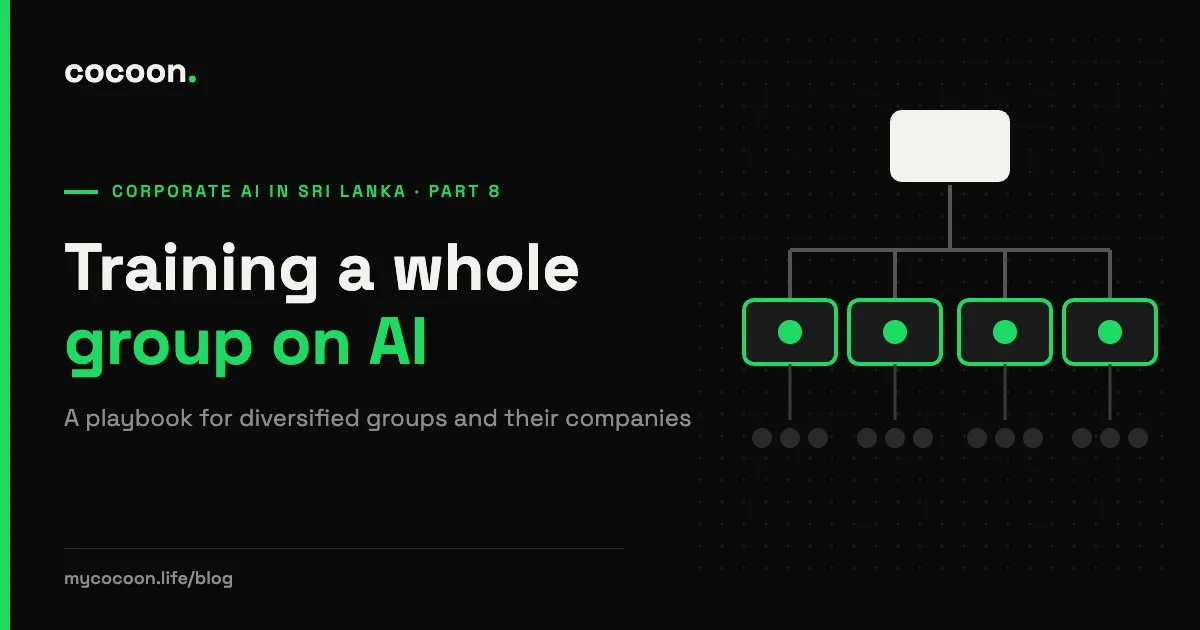
The model that handles all of this is a hub and spokes.
The hub is a small group-level AI council, usually led by group HR with group IT, legal or compliance, and a business sponsor from the group board. It sets the standards, negotiates tools once for everyone, runs measurement, and keeps a shared library that every company can draw from.
The spokes are the companies. Each one has a sponsor on its own leadership team, a set of champions, and its own use cases tied to its own targets. The spokes decide what to work on. The hub makes sure they all work safely and can learn from each other.
What should be the same everywhere?
| Same across the group (hub) | Different in each company (spokes) |
|---|---|
| Staff AI-use guideline and data rules | The use cases worth starting with |
| Approved tools and how accounts are set up | Examples and exercises used in training |
| The readiness measure, used before and after | Pace and order of teams |
| The definition of an AI champion and their time | The language mix of sessions |
| A shared prompt and workflow library | Which workflows to automate first |
| A leadership briefing for every company's top team | Targets tied to the company's own plan |
The guideline is the one to get right first. Sri Lanka's Personal Data Protection Act brings its main duties for companies into operation on 1 January 2027, according to the Data Protection Authority's announcement. One clear group guideline, adapted lightly where a company's data is unusually sensitive, is far stronger than each company writing its own. We cover what it needs in the PDPA and AI at work.
Where to start: two companies, two functions
A group does not need to start everywhere at once. The pattern that works is two plus two.
Two companies that are ready. Pick companies whose CEOs are keen, whose people already use AI informally, and whose results will be visible to the rest of the group. Success there becomes the internal case study that pulls the other companies in.
Two functions every company has. Finance and HR exist in every business in the group. Training them first, across companies, builds shared prompts and templates that every company can reuse, and it builds a group-wide network of champions in the functions that will run the wider rollout.
Get the Sri Lanka AI Rollout Kit
Eight pages you can use this week: the 90-day plan on one page, a leadership readiness check, a PDPA-aware staff AI-use guideline, a training-needs survey, a use-case worksheet, a one-page business case and ten questions to ask any training provider.
Shared services first
Many Sri Lankan groups run shared service centres for finance, HR, procurement or IT support. These are often the single best place to start.
A shared service team does the same work for many companies, so every improvement multiplies across the group. Month-end reconciliations, payroll queries, supplier onboarding, policy questions and IT help requests are full of repeated reading and writing that AI speeds up with a person checking. Shared services also tend to have documented processes already, which makes it easier to move from faster work to properly automated steps.
We would add one caution. Shared services handle a lot of personal and financial data. They should be the most careful users in the group, not the most adventurous, which is another reason to settle the group guideline before training starts.
One view across the group
The biggest advantage a group has over a single company is comparison. If every company uses the same readiness measure, before and after, group HR gets a heat map: which companies and which functions are moving, which are stuck, and where to send help.
Our free AI Readiness Score works at individual, team and organisation level, and the Team Capability Map shows where a team is only one person deep. For a confidential, organisation-wide picture with a report under your own name, there is our Private AI Readiness Audit.
Measure every quarter, share the results with every company's leadership, and celebrate the teams that moved most. Many Sri Lankan groups already run strong internal awards. An AI category, judged on working builds and measured results, fits naturally into that culture.
Four mistakes groups make
One keynote for everyone. A famous speaker in a ballroom for five hundred people from twenty companies is memorable, and it changes almost nothing. Use it to launch, if at all, never as the programme.
Buying licences before habits. Group-wide licences for an AI tool nobody has been trained to use well are an expensive way to learn that tools are the easy part.
Every company writing its own rules. It looks like respect for autonomy. In practice it means inconsistent protection and confused staff who move between companies.
No group view. Without one measure across companies, group leadership cannot tell what is working, and the programme gets judged on anecdotes.
If your group is ready to plan this, our bespoke training team designs group programmes around your companies' real processes, and our 90-day rollout plan shows how one company's quarter fits inside the wider picture. The apparel and hospitality parts of this series cover two of the sectors most groups include: apparel and hotels and tourism.
One thing to try this week: write down the two companies in your group most ready for AI, and the two functions that every company shares. Put the four names on one page and take it to your next group leadership meeting.
Get the Sri Lanka AI Rollout Kit
Eight pages you can use this week: the 90-day plan on one page, a leadership readiness check, a PDPA-aware staff AI-use guideline, a training-needs survey, a use-case worksheet, a one-page business case and ten questions to ask any training provider.
- How to Roll Out AI Across a Sri Lankan Company in 90 Days
- Sri Lanka's PDPA and AI at Work: What Staff Can and Cannot Paste into ChatGPT
- What Does Corporate AI Training Cost in Sri Lanka? How to Compare Quotes
- AI Training for Teams Who Work in Sinhala and Tamil
- AI Training for Sri Lanka's Apparel Industry: Where the Hours Really Go
- AI Training for Sri Lankan Hotels and Tourism Teams
- After the Brain Drain: How AI Upskilling Helps Sri Lankan Teams Do More With the People Who Stayed
- Training a Whole Group on AI: A Playbook for Sri Lanka's Diversified Conglomerates
Frequently asked questions
How should a conglomerate approach AI training?
Use a hub and spokes model. A small group AI council sets the staff guideline, approved tools, readiness measure, champion role and shared library. Each company chooses its own use cases, examples and pace. Start with two ready companies and two functions every company shares, then scale on evidence.
What should be standardised across a group of companies?
The staff AI-use guideline and data rules, approved tools and account set-up, the readiness measure used before and after, the definition and time allowance of AI champions, a shared prompt and workflow library, and a leadership briefing for each company's top team.
Why start AI training with shared services?
Shared service teams such as finance, HR, procurement and IT support do the same work for many companies, so every improvement multiplies across the group. They often have documented processes, which makes later automation easier, though they must be especially careful with personal and financial data.
How do you measure AI adoption across a group?
Use the same readiness measure in every company, before and after training, and review it quarterly as a heat map by company and function. Add counts of working builds and time saved on tracked tasks.
Who should lead AI adoption in a diversified group?
Usually group HR, working with group IT and legal or compliance, with a sponsor from the group board. Each company also needs its own sponsor on its leadership team and a set of AI champions.
Sources
Planning AI across several companies? Book a free 30-minute call and we will sketch the first quarter with you.
Book a free call →