ECRS Explained: Eliminate, Combine, Rearrange, Simplify (Before You Automate)
Before Toyota was a byword for efficiency, its engineers asked four questions of every step on the line. Can we eliminate it? Combine it? Rearrange it? Simplify it? In that order. The method is called ECRS, and it has quietly outlived dozens of management fads because it works.
It works just as well on an inbox as on an assembly line. That is why our Workflow Mapper runs ECRS over every map it draws, and why we teach it before we teach a single automation tool.
The four questions
E: Eliminate
Does this step need to exist at all? Look for reports nobody reads, approvals nobody refuses, copies of data that already live somewhere else. Elimination is the only improvement with zero ongoing cost: no licence, no maintenance, no training. The best automation is the step you deleted.
C: Combine
Can two steps become one? Three separate approval requests can become one daily approval block. Two people checking the same document can become one checklist. Combining cuts handoffs, and handoffs are where work goes to wait.
R: Rearrange
Would a different order or timing remove a wait? Move the pricing check before the proposal is written, not after. Batch the reporting into a fixed weekly window instead of ad hoc nights. Rearranging is often where the biggest delays disappear, because most delays are about sequence, not effort.
S: Simplify
Can what remains be made easier? A template instead of a blank page. Three reminder tones pre-approved instead of rewritten every time. A form instead of a free-text email. Simplify last, because by now you are only polishing steps that deserve to exist.
Only then, and only for what is left, do you ask the fifth question: can AI automate or accelerate this?
ECRS on a real map
Here is the leverage report the Workflow Mapper produced for a business owner's role. Every card is one recommendation, labelled with its ECRS action, tied to real step numbers on the map, and ranked by impact against effort:
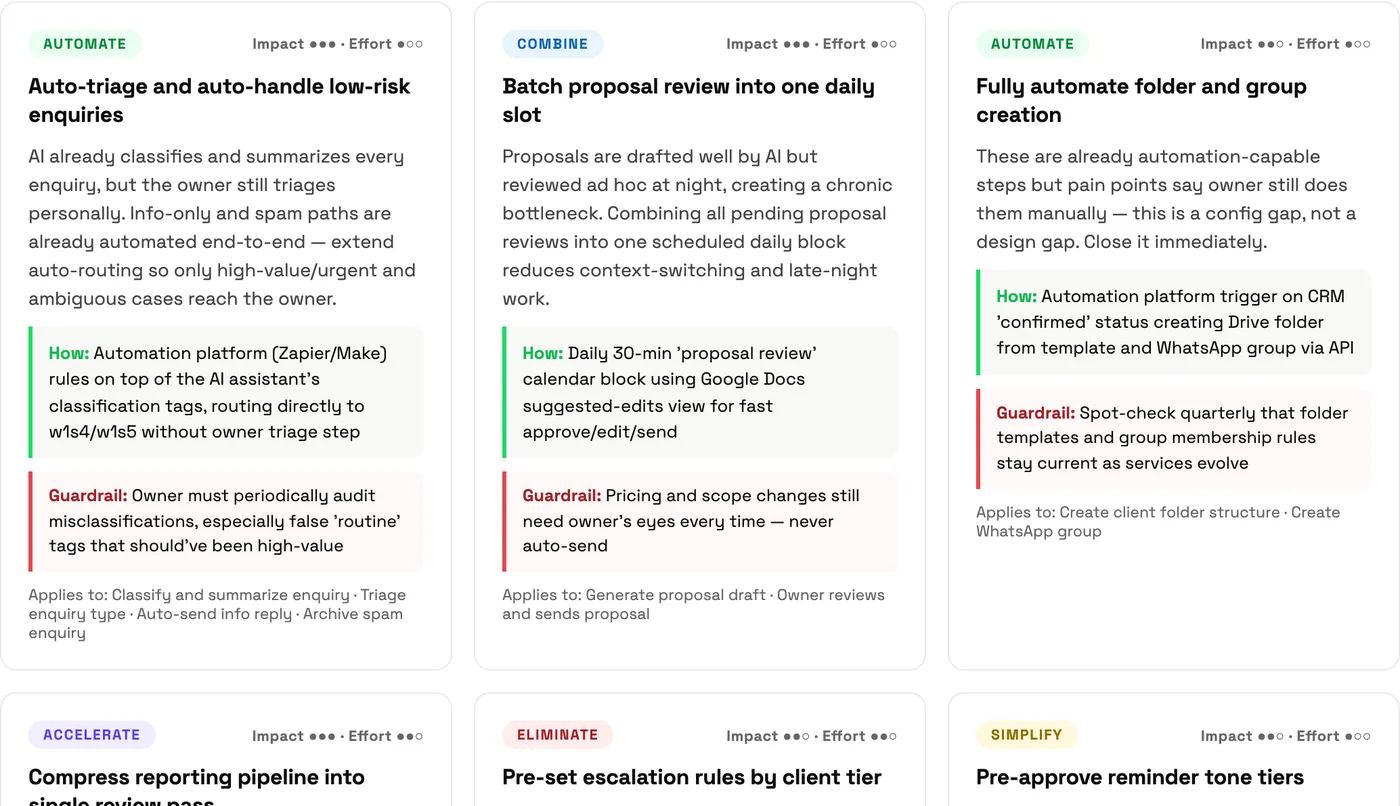
Notice two things. First, "Combine" sits right next to "Automate": batching every proposal review into one daily block is worth as much as any AI feature. Second, every card ends with a guardrail. Our rule is that no recommendation ships without one. Automating the triage is fine; the owner still spot-checks what got auto-handled. Guardrails are how you keep trust while taking work off people's plates.
The six wastes of knowledge work
ECRS needs something to aim at. In factories that is the classic lean wastes. In office work we look for six, and the mapper names the ones actually visible in your map, with the step numbers as evidence:
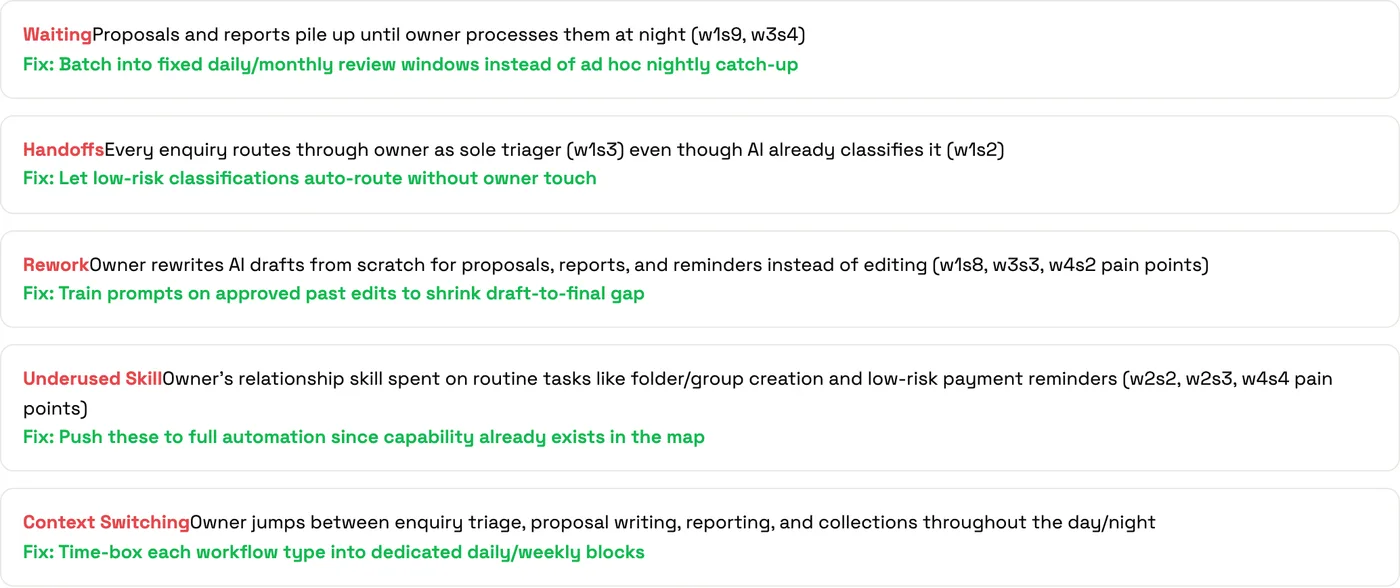
- Waiting: work parked until someone gets to it. Usually the biggest.
- Handoffs: every pass between people adds delay and a chance to drop context.
- Overprocessing: more polish, checks or detail than the outcome needs.
- Rework: doing it twice because the first version was not right, like rewriting an AI draft from scratch.
- Context switching: jumping between unrelated tasks all day, paying a restart cost each time.
- Underused skill: your most expensive person doing routine work a system could do.
A 10-minute ECRS pass you can do today
- Take one workflow you mapped (or map one first, see what is workflow mapping).
- For each step, ask E, then C, then R, then S. Write the first "yes".
- Circle every wait longer than a day. Ask which R would remove it.
- Only now mark what is left as "could run itself" or "AI assists".
- Pick three changes you can make this week without buying anything. The mapper calls these quick wins:

If ECRS feels like common sense, that is the point. Common sense applied systematically, step by step, is rarer than any AI model.
Learn it with Cocoon
ECRS is a core module in our business and leadership programmes because it is the difference between AI projects that pay back and AI projects that get switched off. Cocoon's trainers have run this exercise with finance teams, schools, agencies and founders across the region; we are the AI training and upskilling company that starts with your process, not a vendor's demo. See our programmes or book a call.
Frequently asked questions
What does ECRS stand for?
ECRS stands for Eliminate, Combine, Rearrange and Simplify. It is a lean improvement method: for every step in a process, ask in that order whether you can remove it, merge it with another step, change its order or timing, or make it easier.
Why is the order of ECRS important?
Each question is cheaper than the next. Eliminating a step costs nothing and saves everything. Simplifying still leaves the step in place. Working in order stops you polishing a step that should not exist.
How does ECRS relate to automation?
Automation is what you do after ECRS. Once a process has been cleaned with ECRS, automate or accelerate what is left. Automating before ECRS locks waste in.
What are the wastes in knowledge work?
The Cocoon Workflow Mapper looks for six: waiting, handoffs, overprocessing, rework, context switching and underused skill. They are the office versions of the classic lean wastes from manufacturing.
Get an ECRS leverage report on your own role: every recommendation tied to a real step, with a guardrail.
Run ECRS on my work →